
Updated: May 6

A next-generation automated, connected, and standardised process for increased safety, efficiency, and sustainability of Li-ion BATTEry REVERSE logistics
BatteReverse aims to enable the next generation of battery reverse logistics (RL). It will develop a more efficient and universal method for battery discharge and first diagnosis for a wide range of Li-ion battery types, safety packaging with a monitoring system reducing thermal runaway risk during transportation of batteries, automated dismantling and sorting of battery components based on a safe and more efficient human-robot collaboration, and a more precise and faster Remaining Useful Life assessment of battery modules for 2nd life applications based on acoustic testing and machine learning algorithms. On top of that, BatteReverse will develop a Battery Data Space with standardised labelling and battery passport functionalities to improve battery identification.
We will connect the stakeholders through a community platform and analyse the entire RL process by a digital twin (DT) simulation that will optimise profitability of RL circular business models. The innovations will be integrated and demonstrated in an operational environment in two use-cases for end-of-first-life (EoFL) EV batteries - recycling and repurposing – mirrored with the DT simulation. By 2026 we expect these developments to contribute to following outcomes: increase recycling efficiency by 5%, raise share of repurposed EoFL batteries to 10%, reduce risk of severe events in reverse logistics to 1/10.000, successfully simulate two successful RL business models and to have a stakeholder’s community platform with 50+ stakeholders.
These outcomes will contribute to the sovereignty of the EU in the battery sector. By further uptake of the developed results beyond the project, BatteReverse targets to avoid the use of 3.691 tonnes/year of primary critical raw materials, on top of that avoid the deployment of 100,8 MWh capacity of new batteries yearly while capturing an extra €30,24 million/year value out of EoFL batteries and avoiding 31 severe risk events/year within the EU RL battery chain by 2029.
Our Role
Data Space Architecture, Development & Deployment
Our team led the technical design and end-to-end implementation of the BatteReverse Data Space, covering the full stack from identity management and policy enforcement to connector deployment and blockchain integration.
Key responsibilities include:
Data Space Connector Deployment: Designing and configuring EDC-based connectors for each stakeholder role in the battery value chain, enabling interoperable and standards-compliant data exchange.
Verifiable Credential Infrastructure: Implementing a credential issuance and verification system that assigns role-specific identities to participants — supporting fine-grained, policy-driven access control at organization, department and user level.
Data Access Policy Design: Authoring ODRL-compliant data access policies and contract definitions, ensuring that data assets are accessible only to verified parties with the appropriate credentials and declared purposes.
Multi-stakeholder Catalog Management: Building and managing a federated data catalog where providers publish assets and consumers discover them — with visibility and access rules enforced transparently at every step.
Blockchain Audit Extension: Integrating a Hyperledger Fabric ledger as an optional extension to the Data Space, enabling providers to log all data transactions and audit access patterns over time in a shared, immutable record.
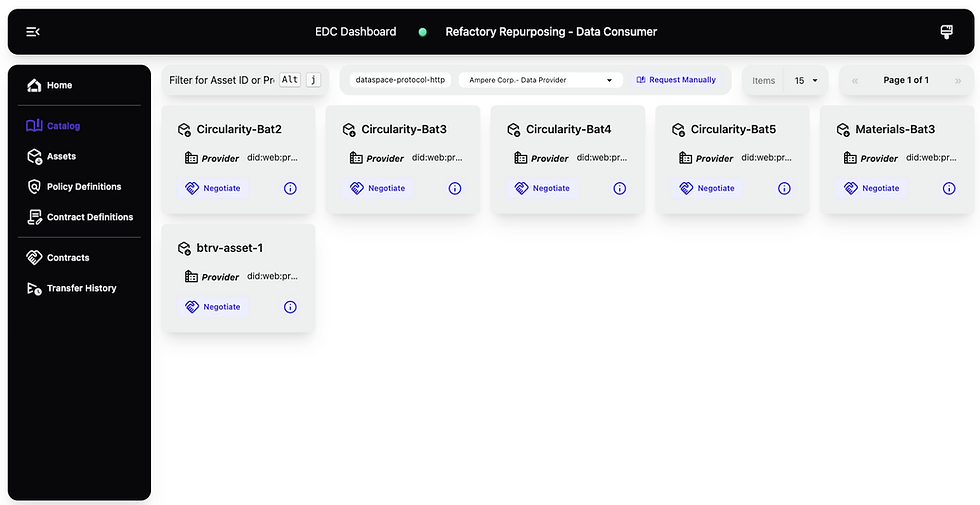
Dashboard & Tooling: Deploying and customising the DataDashboard UI — the operational interface used by all participants to manage assets, define policies, negotiate contracts and initiate data transfers.
Use Case Design & Validation: Designing and executing concrete data exchange scenarios across the stakeholder network, validating the system's behaviour under real-world conditions including access denials, department-level restrictions, and misuse detection.
Through our work, we delivered a production-ready Data Space that demonstrates how sovereign, auditable data exchange can underpin the circular battery economy — from first manufacture to end-of-life processing.


BatteReverse Facts & Figures
Project name: A next-generation automated, connected, and standardised process for increased safety, efficiency, and sustainability of Li-ion BATTEry REVERSE logistics
Grant Agreement No: 101103706
Topic: Streamlined collection and reversed logistics, fully automated, safe and cost-efficient sorting, dismantling and second use before recycling (Batteries Partnership)
Duration: 1/05/2023 – 31/10/2026
EC Contribution: € 4 910 972